ECG learning from one patient’s recordings transfers better
PACE-ECG: Patient-Aware Contrastive ECG Pretraining; Leveraging Longitudinal Structure for Transferable Representations · arXiv:2611.12307
In plain words
An electrocardiogram, or ECG, records the heart’s electrical activity. This paper introduces PACE-ECG, a way to train a computer to recognize useful patterns by comparing different ECGs from the same person, taken within 60 days, while also teaching it to recognize waveform measurements and rhythm labels.
For people who had a heart attack, the researchers tested whether those patterns helped predict later death or heart failure. PACE-ECG scored higher than another pretrained ECG model in the study’s hospital groups, including two groups not used to train its ECG representation.
The research
Strong performance on familiar ECG interpretation tasks may not tell whether a model’s features help predict later outcomes in another healthcare system.
These results make external testing of post-heart-attack prognosis a necessary part of judging that transfer, because a representation’s ranking performance changed across the tested systems and learning approaches.
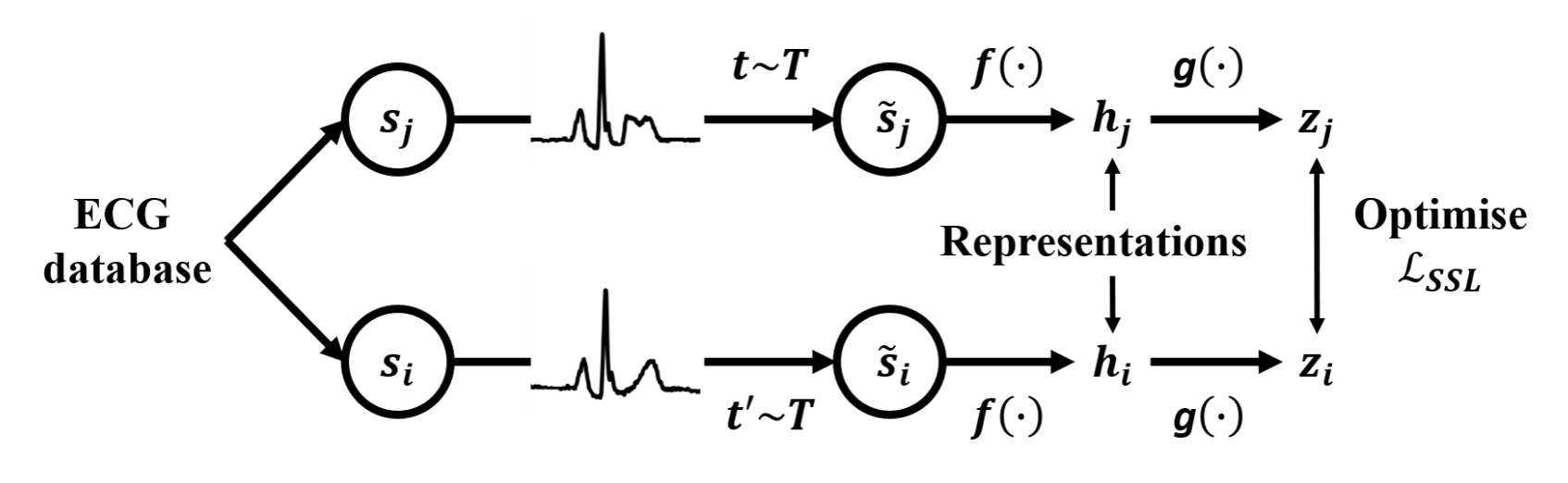
PACE-ECG learns ECG features by pairing nearby recordings from the same patient and adding clinical supervision, then tests their value for post-heart-attack prognosis.
Researchers froze each pretrained ECG encoder, trained prediction heads on MIMIC-IV, and applied them unchanged to two external HEEDB cohorts.
For heart failure in Boston, mean AUROC was 0.779 with PACE-ECG and 0.706 with DeepECG-SSL; AUROC measures how well predictions rank patients with recorded outcomes above those without them.
PACE-ECG also scored higher on mortality and in Atlanta. These means across five head-initialization seeds support better discrimination in the tested cohorts, though the main comparison changes multiple pretraining features.
The pairing test kept auxiliary supervision and changed the positive-pair definition, so it cannot show whether the gain came from patient identity, the 60-day timing, or their interaction with that supervision.
Outcomes were recorded over follow-up periods that varied between patients and cohorts; the AUROC results do not establish performance at a shared prediction horizon, calibration, or clinical utility.
What the evidence shows
- A different goal for ECG learning
PACE-ECG is an ECG representation-learning framework: it learns features from heart electrical recordings by pairing distinct recordings from the same patient taken within 60 days, while also predicting waveform measurements and report-derived rhythm labels.
The question is whether this approach retains information useful for prognosis across healthcare systems, where performance on conventional ECG interpretation tests alone may not answer that question.
- Test prediction beyond one system
The main comparison used frozen ECG encoders and prediction heads trained on MIMIC-IV, then applied unchanged to two independent HEEDB groups. AUROC measures how well a model ranks patients who experience an outcome above those who do not.
On this 0–1 scale, PACE-ECG scored 0.779 for heart failure in Boston, compared with 0.706 for DeepECG-SSL, another pretrained ECG representation.
- The difference extends externally
The advantage also appeared for mortality and in the other cohorts. In Atlanta, for example, mean heart-failure AUROC was 0.787 for PACE-ECG and 0.709 for DeepECG-SSL.
The means summarize five prediction-head initialization seeds, not every model run. Because the two pretrained representations differ in data, architecture, and supervision, this comparison shows a performance difference without identifying which pretraining difference caused it.
- A closer test of the pairing rule
A matched comparison helps assess the pairing rule within PACE-ECG's training setup. It kept the dataset, architecture, and auxiliary supervision, but compared distinct nearby recordings from one patient with two altered views of one ECG.
In external cohorts, the patient-linked version's heart-failure AUROC was higher by 0.0676 in Boston and 0.0680 in Atlanta. The contrast supports the pairing scheme in this combined objective, but does not separate the effects of timing and patient identity.
- What the evidence can support
Across the evaluated post-heart-attack outcomes and cohorts, the results support the interpretation that pretraining design affects transfer and that in-system performance alone cannot establish clinical generalisability.
The tested outcomes, cohorts, and external model comparison are limited in number, and the study does not establish calibration or clinical usefulness. Its conclusions concern discrimination over each cohort's available follow-up.
Deep
- Original paper authors
- Riccardo Cavarra, Lupo Lovatelli, Shaheim Ogbomo-Harmitt, Jakub Grzelak, Adelaide De Vecchi
- Submitted to arXiv
- License
- CC BY 4.0